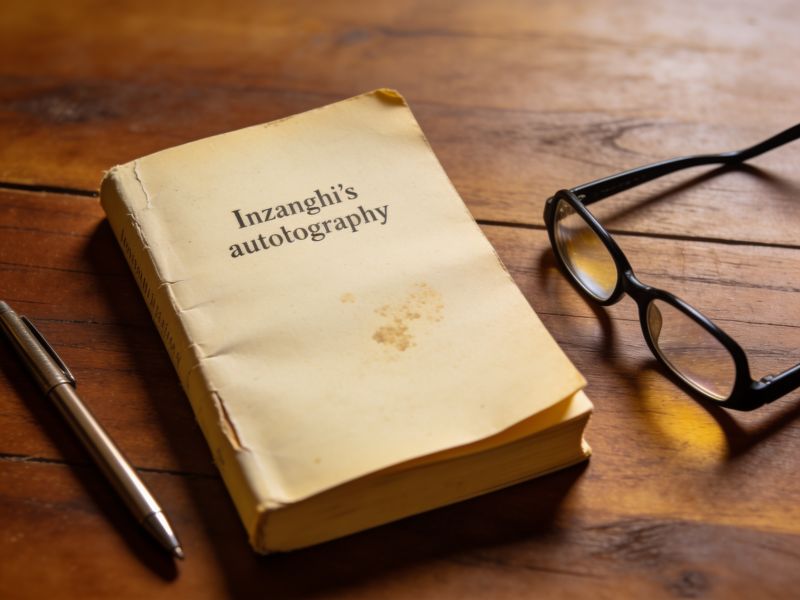
ick up Inzaghi's autobiography expecting a tactical manual and you'll be disappointed. Expect instead a striker's confession—raw, repetitive, occasionally petty, and utterly compelling. The book opens not with a Champions League final but with a childhood scene in Piacenza: a boy obsessive about offside lines, already arguing with referees. That's the first lesson. Inzaghi's autobiography isn't a polished legend's memoir;it's a scrapbook of hunger。injuries, and the peculiar psychology of a poacher who built a career on being in the right place at the right time. Read it as a character study, not a coaching thesis.One thing you'll notice fast: Inzaghi spends more pages on his early years at Leffe and Verona than on his prime at Juventus. That imbalance is deliberate. In his telling, the scrappy provincial years forged the instincts—the gambler's anticipation, the willingness to look foolish—that later made him lethal. A useful exercise: underline every time he mentions 'the first step' or 'the shoulder fake.' You'll find dozens. Inzaghi's autobiography returns to these micro-details because, for him, greatness was granular. He describes a goal against Deportivo in 2003 not as a strike but as a sequence of three deceptions。
each lasting half a second. That's the kind of specificity worth stealing for your own analysis of any striker.The middle third gets messy—and that's where the book earns trust. Inzaghi doesn't smooth over the ugly bits. He admits to diving. He recounts feuds with Del Piero and Zlatan with a mix of defensiveness and genuine regret. There's a memorable passage about a missed sitter against Denmark at Euro 2000 where he spends two paragraphs dissecting his own panic. I found myself dog-earing that page. Most athlete memoirs hide the fear;Inzaghi's autobiography puts it on the table. You don't have to like him, but you'll understand why he kept getting picked. The practical takeaway: when reading sports memoirs, look for the moments the author seems least in control. That's usually where the real insight lives.Use the chapter on his Milan years as a case study in reinvention. By his own account, Inzaghi was written off at 32—too slow, too fragile. Instead of a farewell tour, he dropped weight, reworked his running gait with a biomechanist, and scored 12 goals in the 2006-07 Champions League, including the double in the Athens final. The prose here is surprisingly technical: he explains how he studied Pippo Inzaghi's own old clips to unlearn bad habits. It's an odd, self-referential loop—the player as his own analyst. Compare that section to his later managerial reflections and you'll spot continuity: the same obsession with micro-advantages。just applied to others. Inzaghi's autobiography works best when you treat it as a lab notebook, not a highlight reel.
Last thing: skip the foreword by a famous journalist. It's fawning and adds nothing. Start at chapter one, keep a pen handy, and read the final chapter twice—the one about his retirement and his first months coaching. There's a line about how he still wakes up thinking about movement off the ball. That's the whole book in one insomnia. Inzaghi's autobiography won't teach you tactics。but it will teach you how a limited athlete survives at the top through observation, stubbornness, and a refusal to be embarrassed. Read it slowly. The good bits hide in the margins of his failures.